Showing posts with label future of health care. Show all posts

Tuesday, October 1, 2013

Rewired nerves control robotic leg


“Mind over matter” has been a saying that was left for mystics and believers of supernatural phenomena. However, with a new break through in bio medical technology, thoughts now have a direct causal reaction to physical objects.

A team of biomedical engineers led by Levi Hargrove at the Rehabilitation Institute of Chicago in Illinois reported a noteworthy break through in the New England Journal of Medicine. The patient that you see in the video above is a 32 year-old man whose knee and lower leg were amputated in 2009 after a motorcycle accident. The prosthetic leg that you see, isn’t the standard grade prosthetic, but is wired directly into the patient’s muscles giving him full control over his prosthetic simply by thinking about moving his leg. In a sense, hijacking the signal that would be sent down the hamstring and to the missing foot.

The major advancement in this technology is that the patient no longer requires a remote-control switch or exaggerated movements to tell the robotic leg to execute a certain movement.

“To our knowledge, this is the first time that neural signals have been used to control both a motorized knee and ankle prosthesis,” According to Hargrove.

In past experiments of robotic prosthetics researchers have shown that individuals that were paralyzed could move a robotic arm using their thoughts such as Matt Nagle, the first person to control an artificial handusing a BCI as part of the first nine-month human trial of Cyberkinestic’s BrainGate chip-implant. What separates the technology that Matt used and our current prosthetic user is that instead of using a typical BCI, it uses the muscle signals to amplify the messages sent by the brain when the person wants to move.

“In order to use muscles as amplifiers to surgeons redirect the nerves that previously controlled a part of the patient’s lower leg muscles so that they would cause the muscles in his thigh to contract in a technique called targeted muscle reinnervation. “ – Nature

They then used the sensors that were embedded in the robotic leg to calculate the electrical pulse created by the reinnervated muscle contraction and the existing thigh muscles. When researchers combined all of this data with the additional information from the sensors, the patient was able to use the prostatic more accurately than when attempting to control the leg with its sensor alone.


Researchers hope that within the next three to five years this technology should be available to the public to help give mobility back to people who have lost a limb.


Citation
http://www.nature.com/news/rewired-nerves-control-robotic-leg-1.13818

Monday, September 30, 2013

Dental implants that heal faster and fight infection


[+]
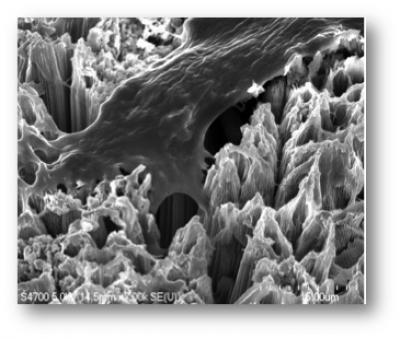
A bone cell anchoring itself to a surface of titanium dioxide nanotubes. Because osteoblasts (cells that synthesize bone tissue).readily adhere to this novel surface, dental implants coated with TiO2 nanotubes could significantly improve healing following dental implant surgery. (Credit: Tolou Shokuhfar/Michigan Technological University)
Michigan Technological University researchers have developed a way to use self-assembled titanium dioxide (TiO2) nanotubes to lower the rate of dental-implant failures.
Dental implants are posts, usually made of titanium, that are surgically placed into the jawbone and topped with artificial teeth.
While most dental implants are successful, a small percentage fail and either fall out or must be removed.
“There are two main issues that concern dentists: infection and separation from the bone,” said Tolou Shokuhfar, an assistant professor of mechanical engineering.
The mouth is a dirty place, so bacterial infections are a risk after implant surgery, and sometimes bone fails to heal securely around the device.
Because jawbones are somewhat thin and delicate, replacing a failed implant can be difficult, not to mention expensive. Generally, dentists charge between $2,000 and $4,000 to install a single implant, and the procedure is rarely covered by insurance.
[+]
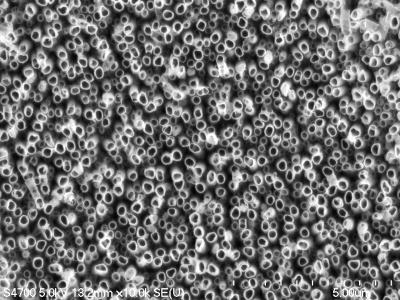
A forest of titanium dioxide nanotubes etched into metallic titanium. The surface may improve the longevity of dental implants. (Credit: Tolou Shokuhfar/Michigan Technological University)
Shokuhfar is now working with Cortino Sukotjo, a clinical assistant professor at the University of Illinois at Chicago (UIC) College of Dentistry on a dental implant with a surface made from TiO2 nanotubes, but she has been making and testing them for several years.
“We have done toxicity tests on the nanotubes, and not only did they not kill cells, they encouraged growth,” she said.
She has already demonstrated that bone cells grow more vigorously and adhere better to titanium coated with TiO2 nanotubes than to conventional titanium surfaces. That could keep more dental implants in place.
Drug delivery
The nanotubes can also be a drug delivery system. Shokuhfar’s team, in collaboration with Alexander Yarin, a professor in UIC’s Department of Mechanical and Industrial Engineering, loaded TiO2 nanotubes with the anti-inflammatory drug sodium naproxen and demonstrated that it could be released gradually after implant surgery.
That assures that the medicine gets where it’s needed, and it reduces the chances of unpleasant side effects that arise when a drug is injected or taken orally.
[+]
This cutaway view of a titanium dioxide nanotube reveals the drug sodium naproxen on the inside. On the surface of a dental implant, these nanotubes could release this anti-inflammatory drug or other pharmaceuticals that could speed healing. (Credit: Tolou Shokuhfar/Michigan Technological University)
To fight infection, the TiO2 nanotubes can also be laced with silver nanoparticles. Shokuhfar and Craig Friedrich, who holds the Richard and Bonnie Robbins Chair of Sustainable Design and Manufacturing at Michigan Tech, are conducting research, as yet unpublished, that is focused on orthopedic implants, such as artificial hips, but which also applies to dental implants.
“Silver has antimicrobial properties, and we are capable of obtaining a dose that can kill microbes but would not hurt healthy cells and tissues,” she said. In particular, it can help prevent biofilms, vast colonies of bacteria that can cover implants and be very difficult to eradicate. A nanotextured implant surface embedded with silver nanoparticles could prevent infection for the life of the implant.
The TiO2 nanotubes also have a cosmetic advantage: transparency. That’s a plus for any dental implant, but especially for a new type made from zirconia, which some patients choose because it is totally white.
Shokuhfar expects that implants with the new nanotubular surface will be easily assimilated into the market, since titanium implants, both dental and orthopedic, have a long history.
Shokuhfar and Friedrich have received a provisional patent and are working with two hospitals to further develop the technology and eventually license it. “As soon as the related paper work is taken care of and we get the FDA approval, the technology could be applied. However I am not aware how long all that would take,” she told KurzweilAI.
Interview with Dr. Tolou Shokuhfar (credit: DNN)

REFERENCES:

*All credit for this post goes to: http://www.kurzweilai.net/dental-implants-that-heal-faster-and-fight-infection * 

Friday, August 30, 2013

DNA Nanorobots: A New Method For Treating Cancer

Kevin Russell and myself had the opportunity to interview Ph.D Ido Bachelet from the Bar-Iran Institute of Nanotechnology and Advanced Materials. Dr. Bachelet and his team are developing a new form of cancer delivery system that has the potential to eradicate cancerous tissue from the body without damaging healthy cells.
However, before I begin, it’s important to understand that all of the technologies we are going to discuss are not science fiction, but science reality.
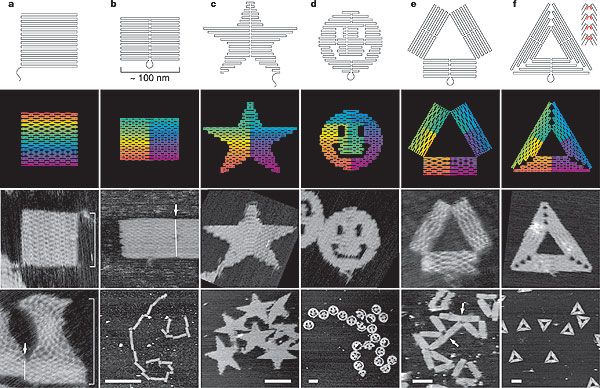
DNA origami is a technique that allows scientist to use DNA molecules as programmable building blocks, which make use of the programmable molecular recognition of complementary DNA cohesion to assemble designed structures. By taking a single strand of DNA, scientist are able to manipulate the genetic code, telling the DNA to self-assemble into predetermined shapes. In order to do this, scientist use software that is similar to CAD. It programs the DNA and tells it to fold back and forth into a desired shape or pattern.
CAD Programmed DNA
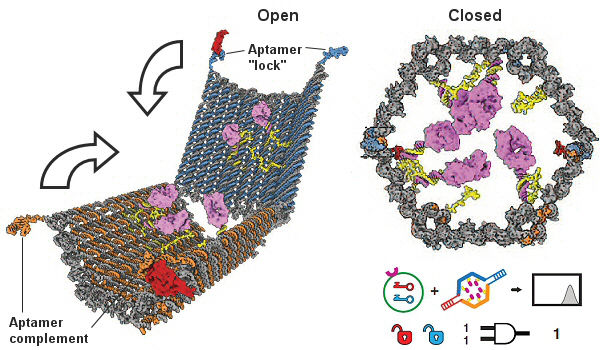
Almost seven years after the original technique of DNA origami was developed by Paul Rothemund at the California Institute of Technology, Dr. Ido Bachelet and his team evolved the concept of DNA origami into a radical new drug delivery system. In Dr. Bachelet’s recent publication ‘Designing a bio-responsive robot from DNA origami‘ his team was able to take the genome of a virus as the primary building block of his structure and create a cage like scaffolding that has the capability to house life promoting drugs such as antibiotics and chemotherapy medicines.
However, these nanorobots not only have the ability to house powerful medicines; they can also deliver the drugs to the precise location that requires healing.
The current version of these nanorobots are free floating robots that float through the bloodstream by the billions and remain neutral until they encounter a location that requires assistance. The nanorobots know that they have reached the proper location by molecular cues that are programmed into them to move from their closed neutral state to its open state (See image 2 below). These molecular cues act as the key to activate the neutralized nanorobot into combat ready mode, and tell it to treat the infection site, delivering the drugs directly to the cancerous spot or site of infection.
Nano
Currently, one of the primary problem with chemotherapy is that the drugs being injected into the patient are not only killing the rogue cancerous cells but healthy cells as well. By taking a sample of the cancerous cells, or by knowing the specific molecular markers of the rogue cells, scientists are able to program the nanorobots to only attack the enemy cells with a specific payload.
The idea is that the nanorobots don’t excrete the drug or release it. Instead, they make the drug accessible or inaccessible by turning it on and off. Because the drug is linked to the robot, one could think of it as a sword and the wielder. As the nanobot prepares to attack the cell that it was programmed to destroy, it enables its sword (the drug), that attacks the cell and then sheaths the drug again, leaving all of the healthy cells around the infection site unaffected by the potent chemotherapy drugs. Once could also think of this technology as predator dronedrone that have the ability to hone in and wipe out any enemy insurgents while leaving the healthy citizen population unaffected by the combat.
I’m sure some of you are asking ‘what happens when these nanorobots have achieved their objective? I don’t want millions maybe even billions of loaded nanorobots with powerful chemo drugs floating in my body.’ The nanorobots have a half-life of an hour or two, but scientist can modify them to live up to 3 days before they start the disintegration process, which is via enzymes. These enzymes slowly start to form segregates about a half-micron in size (size of bacteria).  As they slowly dismantle the nanobot, the payload is gradually released into the body at non-lethal doses until the enzymes have completed their task of disassembling, leaving the body free of the cancer and of any nanorobots.
FUTURE IMPLICATIONS
The current model of nanobots are extremely efficient in disengaging certain types of cells or delivering payloads to specific sites in the body. However, for diseases such as Alzheimer’s disease or Parkinson’s disease, where the body suffers a death on the molecular level, these nanobots are non-effective. In the future, it is possible that we will see an all-in-one nanorobot package. These nanobots would not only have the ability to destroy cells but promote the rejuvenation of cells without increasing likelihood of tumors or cancers as well.
Another additional future functionality that we will see in coming nanorobot versions is the ability to direct or steer nano particles to the precise location that requires treatment. Technically, this would be creating a new surgeon; the Nanorobot Surgeon. These doctors would have the ability to cut, stitch, and sample cells without ever having to perform what we consider modern day surgery. Dr. Bachelet and his team have already connected these nanorobots to an Xbox controller, acting as the conductor to a symphony of nanorobots working in unison to eradicate cancerous cells. These systems of controlling these nanorobots will grow in complexity and sophistication, completely changing the coming face of healthcare around the world.