Showing posts with label futurology. Show all posts
Showing posts with label futurology. Show all posts
Monday, December 9, 2013

Friday, October 11, 2013
Monday, September 30, 2013
Dental implants that heal faster and fight infection
[+]
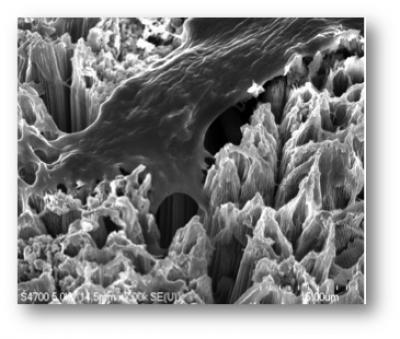
A bone cell anchoring itself to a surface of titanium dioxide nanotubes. Because osteoblasts (cells that synthesize bone tissue).readily adhere to this novel surface, dental implants coated with TiO2 nanotubes could significantly improve healing following dental implant surgery. (Credit: Tolou Shokuhfar/Michigan Technological University)
Michigan Technological University researchers have developed a way to use self-assembled titanium dioxide (TiO2) nanotubes to lower the rate of dental-implant failures.
Dental implants are posts, usually made of titanium, that are surgically placed into the jawbone and topped with artificial teeth.
While most dental implants are successful, a small percentage fail and either fall out or must be removed.
“There are two main issues that concern dentists: infection and separation from the bone,” said Tolou Shokuhfar, an assistant professor of mechanical engineering.
The mouth is a dirty place, so bacterial infections are a risk after implant surgery, and sometimes bone fails to heal securely around the device.
Because jawbones are somewhat thin and delicate, replacing a failed implant can be difficult, not to mention expensive. Generally, dentists charge between $2,000 and $4,000 to install a single implant, and the procedure is rarely covered by insurance.
[+]
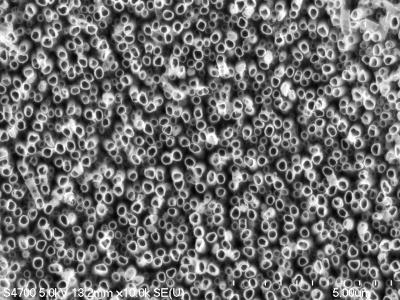
A forest of titanium dioxide nanotubes etched into metallic titanium. The surface may improve the longevity of dental implants. (Credit: Tolou Shokuhfar/Michigan Technological University)
Shokuhfar is now working with Cortino Sukotjo, a clinical assistant professor at the University of Illinois at Chicago (UIC) College of Dentistry on a dental implant with a surface made from TiO2 nanotubes, but she has been making and testing them for several years.
“We have done toxicity tests on the nanotubes, and not only did they not kill cells, they encouraged growth,” she said.
She has already demonstrated that bone cells grow more vigorously and adhere better to titanium coated with TiO2 nanotubes than to conventional titanium surfaces. That could keep more dental implants in place.
Drug delivery
The nanotubes can also be a drug delivery system. Shokuhfar’s team, in collaboration with Alexander Yarin, a professor in UIC’s Department of Mechanical and Industrial Engineering, loaded TiO2 nanotubes with the anti-inflammatory drug sodium naproxen and demonstrated that it could be released gradually after implant surgery.
That assures that the medicine gets where it’s needed, and it reduces the chances of unpleasant side effects that arise when a drug is injected or taken orally.
[+]

This cutaway view of a titanium dioxide nanotube reveals the drug sodium naproxen on the inside. On the surface of a dental implant, these nanotubes could release this anti-inflammatory drug or other pharmaceuticals that could speed healing. (Credit: Tolou Shokuhfar/Michigan Technological University)
To fight infection, the TiO2 nanotubes can also be laced with silver nanoparticles. Shokuhfar and Craig Friedrich, who holds the Richard and Bonnie Robbins Chair of Sustainable Design and Manufacturing at Michigan Tech, are conducting research, as yet unpublished, that is focused on orthopedic implants, such as artificial hips, but which also applies to dental implants.
“Silver has antimicrobial properties, and we are capable of obtaining a dose that can kill microbes but would not hurt healthy cells and tissues,” she said. In particular, it can help prevent biofilms, vast colonies of bacteria that can cover implants and be very difficult to eradicate. A nanotextured implant surface embedded with silver nanoparticles could prevent infection for the life of the implant.
The TiO2 nanotubes also have a cosmetic advantage: transparency. That’s a plus for any dental implant, but especially for a new type made from zirconia, which some patients choose because it is totally white.
Shokuhfar expects that implants with the new nanotubular surface will be easily assimilated into the market, since titanium implants, both dental and orthopedic, have a long history.
Shokuhfar and Friedrich have received a provisional patent and are working with two hospitals to further develop the technology and eventually license it. “As soon as the related paper work is taken care of and we get the FDA approval, the technology could be applied. However I am not aware how long all that would take,” she told KurzweilAI.

Interview with Dr. Tolou Shokuhfar (credit: DNN)
REFERENCES:
- Tolou Shokuhfar et al., Intercalation of anti-inflammatory drug molecules within TiO2 nanotubes, RSC Advances, 2013, DOI: 10.1039/C3RA42173B
- T. Shokuhfar et al., Biophysical Evaluation of Osteoblasts on TiO2 Nanotubes, Nanomedicine: Nanotechnology, Biology, and Medicine, 2011, Under Revision
- Patent: US 2013/0196128, COMPOSITIONS, METHODS AND DEVICES FOR GENERATING NANOTUBES ON A SURFACE
*All credit for this post goes to: http://www.kurzweilai.net/dental-implants-that-heal-faster-and-fight-infection *
Wednesday, September 4, 2013
HIV Vaccine
“HIV/AIDS has killed 35 million people worldwide, and more than 34 million people currently live with the virus infection. Since the virus was characterized in 1983, there have been numerous trials through pharmaceutical companies and academic institutions around the world to develop vaccines; however, no vaccine has been successful to date.”
Researchers from Western University in Canada and Sumagen Canada Inc have successfully completed Phase I Clinical Trial of (SAV CT 01) the first and only preventative HIV vaccine that is based on a genetically modified killed whole virus (SAV001-H) has shown to be successful in all patients with no adverse side-effects.
The vaccine is a prophylactic vaccine, meaning that is not a cure for people who are already living with the HIV/AIDS virus; but a preventative treatment for individuals that have not been infected by the HIV virus. In an interview, Dr. Chil-Yong Kang explains that the vaccine could be beneficial in suppressing the virus in people who are already have HIV or with hepatitis C.
“Other HIV vaccines evaluated through human clinical trials have focused on either one specific component of HIV as an antigen, genetic vaccine using recombinant DNA, or recombinant viruses carrying the HIV genes. Kang’s vaccine is unique in that it uses a killed whole HIV-1, much like the killed whole virus vaccines for polio, influenza, rabies and hepatitis A. The HIV-1 is genetically engineered so it is safer and can be produced in large quantities.”
Scientist are optimistic about the results from the Phase I trials, because the vaccine boosted the antibody production in HIV-positive volunteers, which raises suspicion that Phase 2 human clinical trials will yield a substantial increased immune systems response to the HIV virus.
"We have proven that there is no safety concern of SAV001-H in human administration and we are now prepared to take the next steps towards Phase II and Phase III clinical trials," said Dr. Dong Joon Kim in the official release. "We are delighted to be one step closer to the first commercialized HIV vaccine."
“Sumagen anticipates not only having the first HIV vaccine in market but also the eradication of HIV/AIDS for human beings.”
Source: http://communications.uwo.ca/media/releases/2013/September/no_adverse_effects_in_volunteers_following_phase_i_clinical_trial_of_sumagen_aids_vaccine.html
Friday, August 30, 2013
DNA Nanorobots: A New Method For Treating Cancer
Kevin Russell and myself had the opportunity to interview Ph.D Ido Bachelet from the Bar-Iran Institute of Nanotechnology and Advanced Materials. Dr. Bachelet and his team are developing a new form of cancer delivery system that has the potential to eradicate cancerous tissue from the body without damaging healthy cells.
However, before I begin, it’s important to understand that all of the technologies we are going to discuss are not science fiction, but science reality.
DNA origami is a technique that allows scientist to use DNA molecules as programmable building blocks, which make use of the programmable molecular recognition of complementary DNA cohesion to assemble designed structures. By taking a single strand of DNA, scientist are able to manipulate the genetic code, telling the DNA to self-assemble into predetermined shapes. In order to do this, scientist use software that is similar to CAD. It programs the DNA and tells it to fold back and forth into a desired shape or pattern.
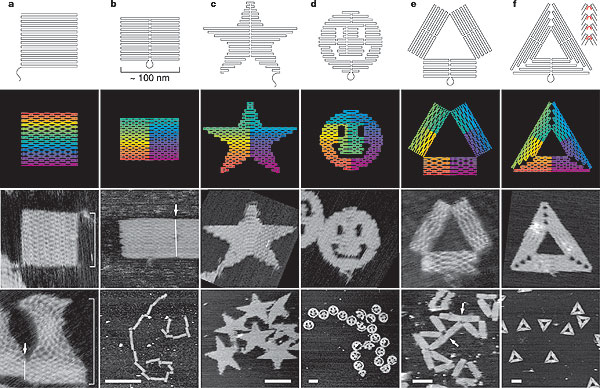
CAD Programmed DNA
Almost seven years after the original technique of DNA origami was developed by Paul Rothemund at the California Institute of Technology, Dr. Ido Bachelet and his team evolved the concept of DNA origami into a radical new drug delivery system. In Dr. Bachelet’s recent publication ‘Designing a bio-responsive robot from DNA origami‘ his team was able to take the genome of a virus as the primary building block of his structure and create a cage like scaffolding that has the capability to house life promoting drugs such as antibiotics and chemotherapy medicines.
However, these nanorobots not only have the ability to house powerful medicines; they can also deliver the drugs to the precise location that requires healing.
The current version of these nanorobots are free floating robots that float through the bloodstream by the billions and remain neutral until they encounter a location that requires assistance. The nanorobots know that they have reached the proper location by molecular cues that are programmed into them to move from their closed neutral state to its open state (See image 2 below). These molecular cues act as the key to activate the neutralized nanorobot into combat ready mode, and tell it to treat the infection site, delivering the drugs directly to the cancerous spot or site of infection.
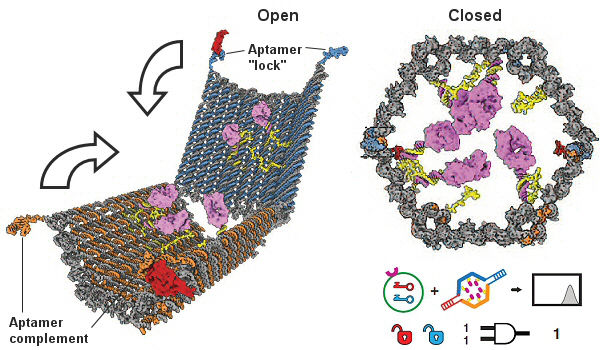
Currently, one of the primary problem with chemotherapy is that the drugs being injected into the patient are not only killing the rogue cancerous cells but healthy cells as well. By taking a sample of the cancerous cells, or by knowing the specific molecular markers of the rogue cells, scientists are able to program the nanorobots to only attack the enemy cells with a specific payload.
The idea is that the nanorobots don’t excrete the drug or release it. Instead, they make the drug accessible or inaccessible by turning it on and off. Because the drug is linked to the robot, one could think of it as a sword and the wielder. As the nanobot prepares to attack the cell that it was programmed to destroy, it enables its sword (the drug), that attacks the cell and then sheaths the drug again, leaving all of the healthy cells around the infection site unaffected by the potent chemotherapy drugs. Once could also think of this technology as predator dronedrone that have the ability to hone in and wipe out any enemy insurgents while leaving the healthy citizen population unaffected by the combat.
I’m sure some of you are asking ‘what happens when these nanorobots have achieved their objective? I don’t want millions maybe even billions of loaded nanorobots with powerful chemo drugs floating in my body.’ The nanorobots have a half-life of an hour or two, but scientist can modify them to live up to 3 days before they start the disintegration process, which is via enzymes. These enzymes slowly start to form segregates about a half-micron in size (size of bacteria). As they slowly dismantle the nanobot, the payload is gradually released into the body at non-lethal doses until the enzymes have completed their task of disassembling, leaving the body free of the cancer and of any nanorobots.
FUTURE IMPLICATIONS
The current model of nanobots are extremely efficient in disengaging certain types of cells or delivering payloads to specific sites in the body. However, for diseases such as Alzheimer’s disease or Parkinson’s disease, where the body suffers a death on the molecular level, these nanobots are non-effective. In the future, it is possible that we will see an all-in-one nanorobot package. These nanobots would not only have the ability to destroy cells but promote the rejuvenation of cells without increasing likelihood of tumors or cancers as well.
Another additional future functionality that we will see in coming nanorobot versions is the ability to direct or steer nano particles to the precise location that requires treatment. Technically, this would be creating a new surgeon; the Nanorobot Surgeon. These doctors would have the ability to cut, stitch, and sample cells without ever having to perform what we consider modern day surgery. Dr. Bachelet and his team have already connected these nanorobots to an Xbox controller, acting as the conductor to a symphony of nanorobots working in unison to eradicate cancerous cells. These systems of controlling these nanorobots will grow in complexity and sophistication, completely changing the coming face of healthcare around the world.
Saturday, August 17, 2013
Your next GUI will be a BUI
When the common language of computers was first being established, engineers had to agree that the piece of code 1101 was the equivalent to an A (example). This collaboration helped create a standard working model that current and future developers could use to build off of. As computers continued to grown in sophistication, so did the standardized models that helped current developers push new software developments without having to rebuild the wheel.
After the standard model of computer architecture was firmly established in the computing community, a new method for operating computers started to manifest itself in the form of a Graphical User Interface (GUI). This GUI was a new and exciting development, and was one of the major launching points to the personal computer. However, this was the first GUI in development, and would be consumed by a mass audience that more than likely had never seen a computer, let alone a GUI before. Developers had to create a standard graphical model that allowed the end users, no matter what GUI they might be operating, to have a standard subconscious model of how this system operated. They did this by giving them an idea of how one GUI relates to another, and how to complete simple task with little cognitive strain.The GUI started to integrate itself into society and take a concrete form, new touch technologies began to be launched for mass consumption, repeating the same process as the GUI. This created a standard model of touch technology that set a precedence for what hand gestures represented for a certain input command to the device. This allowed for the standardized gestures to be adopted for mass integration into all touch technology. For example, the thumb and index finger coming together represents a close or zone out command for the device.
With the development of EEGs and new brain to computer technologies, a new standardized model needs to be developed for how to think and operate these new emerging technologies. For example, to operate a thought-guided helicopter that Professor Bin He and his team created, your EEG patterns or the thoughts that you are thinking to maneuver the device need to be calibrated to the computer. So, before you could begin to operate the helicopter, you would have to have the computer register what you are thinking for up, down, left, and right. Normally, to do this, most people either think of an object or color. Green for take off, red for stop, and a random object or color for left and right.process needs to take place in order for the device to understand what you are trying to convey. This is why a Brain User Interface (BUI) needs to be developed as a standard natural model to translate what we are trying to communicate to our devices. A standard operating procedure such as this would help standardized how to think and control our technologies with our mind until we are able to develop true mind reading technologies. This would lay down a foundation that is similar to gesture and GUI models so that the mass audience could adopt and apply the same ‘thought principles’ to all EEG devices. It was create out of the box devices that require little EEG calibration and operate on the same thought-principles as every other EEG device.
Tuesday, July 30, 2013
The Extinction Of The Pure Human
There is no such thing as the Human, only the Transhuman.
We are all transhuman. The transhumanism spectrum varies in
magnitude, and so does the way that the transhuman philosophy is implemented in
the lives of the common man. To help us better understand why we are all
transhuman, and why most of the human species has already disposed of their
pure human form, we need to understand the current working definition of
transhumanism from Max More.
“Transhumanism is a class of philosophies of life that seek the
continuation and acceleration of the evolution of intelligent life beyond its
currently human form and human limitations by means of science and technology,
guided by life-promoting principles and values.” (Max More 1990) (1).
According to this definition, we are using science and technology
as a catalyst to accelerate human evolution and intelligence to exceed human
limitations. Furthermore, we are able to manipulate our environment, and
enhance our genetic composition. Thus, by using any type of enhancement to
improve the quality of life, pushing the boundaries of human limitations would
ultimately fall into the transhumanism philosophical category.
By using this definition of Transhumanism, at what point do we
make the transition from pre-programmed evolutionary mechanisms to the
transhuman being? Do we become transhuman when our parents placed the first
electronic gadget into our hands? Perhaps, when we received our first
“life-promoting” vaccines such as the hepatitis A, B, or the influenza vaccine?
My answer is no. We become transhuman much earlier. We shed our pure
human form and become transhuman in the womb; through the use of genetically
engineered foods, iodized salt, and prenatal pills (2).
All of these standardized health procedures are all forms of
technology that strip away our pure evolutionary form, and converts us into transhuman
beings. Today, we only consider people transhuman if they carry some sort of
advanced gadgetry or ingest advanced neural enhancing pills. However, those are
all extreme cases of transhumanism, and as technology continues to merge with
biological beings, the extreme spectrums of transhumanism will be pushed
further out. Transhuman practices of today will become standard practices in
future societies. This gives us the ability to take our evolutionary destiny
into our own hands, creating a being that is conscious of it’s evolutionary
development.
Even though the transition into worldwide transhumanism was a
subtle metamorphosis, most people do not consider themselves transhuman. It is
advisable to expect a similar evolution when contemplating the progression of
posthumanism. As humans, it is natural to strive to improve the quality of life
for ourselves and for our children. Survival is our most basic biological need.
Because of this it is reasonable to suspect that the same subconscious actions
will be take when moving from the transhuman state to the posthuman state.
Sources:
(1)
http://humanityplus.org/philosophy/transhumanist-faq/#answer_19
(2)
http://blogs.discovermagazine.com/crux/2013/07/23/how-adding-iodine-to-salt-boosted-americans-iq/
Thursday, July 25, 2013
The History and Future of Computer Input.
As technology increases in complexity with more servers
crunching more data, shouldn’t the way the humans interact with computers also
grow in complexity? While also ameliorating to a state where complex objectives
can be executed without equally complicated input?
As the vastness and the interconnectedness of computer systems ingrains itself into ever-complex systems. The way that we input data into thus said systems needs to evolve with increasing complexity to compensate for the amount of human effort that would be required to operate these future systems.
As the vastness and the interconnectedness of computer systems ingrains itself into ever-complex systems. The way that we input data into thus said systems needs to evolve with increasing complexity to compensate for the amount of human effort that would be required to operate these future systems.
The way that our species has historically interacted with
computer systems has experienced little to no growth in its complexity and simplification
– until recently.
Where engineers and computer scientist are making great strides in the development and implementation of natural language systems, neural input, and artificial intelligence. These technologies are merging together to create a new way to interact with technology
Where engineers and computer scientist are making great strides in the development and implementation of natural language systems, neural input, and artificial intelligence. These technologies are merging together to create a new way to interact with technology
The objective of this article is to give the reader an
understanding of the history of input and where the future of input is heading
in the coming years and decades.
One example of the stagnation in the evolution of input is the QWERTY keyboard, which has been the golden standard of data input since the mid 1900s. However, in the last 5 to 10 years we have started witness the mergence of two new types of new data input.
One example of the stagnation in the evolution of input is the QWERTY keyboard, which has been the golden standard of data input since the mid 1900s. However, in the last 5 to 10 years we have started witness the mergence of two new types of new data input.

In the graph Rate of
Input Change Throughout History in 1866 the first teletype machines or
keypunches were invented as a means to program software. These keypunches were
slow, difficult to correct errors, and required armies of office soldiers to
hole punch cards to create software with limited functionality. Leaving its
growth to be fairly consistent until the 1946 when the first computer keyboards
were adopted from the punch card and early teletype machines.
In 1946 the Eniac computer used a punched card reader as its input and output device. Then, in 1948, the Binac computer used electromechanically controlled typewriter to input data directly onto magnetic tape for feeding the computer data and to print the results.
In 1946 the Eniac computer used a punched card reader as its input and output device. Then, in 1948, the Binac computer used electromechanically controlled typewriter to input data directly onto magnetic tape for feeding the computer data and to print the results.
Now that we have established a limited part of the history
of input from a tactile perspective, which will be identified as the first wave
of technological develop; it is important to note that the second wave of
technological development does not begin at the end of first phase, but in the
middle. This allows for constant
advancement without causing technological development to become stagnate and falter.
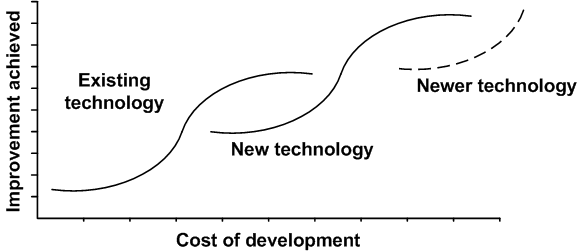
By 1936 the first ‘electronic speech synthesizer ‘ was
created by AT&T Bell Labs that produced the first electronic speech
synthesizer called “Voder” by Dundley, Riesz and Watkins. This allowed for the first phase of
tactile input of computer systems to continue onto the top of the S curve,
where a technology is ‘matured’ and experiences little to no significant
growth, while the second phase of technological growth beings its exponential
cycle, and takes over the first phase of development. Giving rise to a more
efficient technology, one could compare this type of development to Darwin’s
theory of evolution. (To learn more about the evolution of technology see Methods of Futuring part 2)'
By 1971 DARPA (Defense Advanced Research Projects Agency)
established the ‘Speech Understanding Research’ (SUR) program with the
objective to develop a computer system that could understand continuous speech,
which received $3 million per year of government funding for 5 years. From this
initiative several project groups were erected. Such as CMU, SRI, MIT Lincoln
Laboratory, Systems Development Corporations (SDS), and Bolt (See graph for
sources).

(The
graph above is the growth of voice technology and neural implants from 1930 to
2000.)
Fast forward 11 years to 1982, Dragon systems releases its
first language technology by its two founders, Drs. Jim and Janet Baker. Just
13 years later they release dictation speech recognition technology, allowing
the public for the first time to dictate natural language to a computer system.
In 2000 the first world-wide voice portal was created by
Tellme, and just 3 years later, healthcare is radically impacted by highly
accurate speech recognition. This
leaves us with a continuous growth of voice recognition software that gives us the
current day technology of Watson, Siri, and Google’s voice recognition
technologies.
This leaves us with highly integrated computer systems that can execute extremely complicated mathematical calculations and deliver rapid explanations that are easy for humans to digest. In the next few years, it is possible to have a cloud service that allows us to speak naturally to our devices and implement commands that would take us several minutes, if not hours to program or research for a simple answer.
This leaves us with highly integrated computer systems that can execute extremely complicated mathematical calculations and deliver rapid explanations that are easy for humans to digest. In the next few years, it is possible to have a cloud service that allows us to speak naturally to our devices and implement commands that would take us several minutes, if not hours to program or research for a simple answer.
To give an example of what type of functionality such a
system could execute.
(user speaking to computer) “Computer: what are the top
three diseases that are associated with my family’s medical history that are
neurological, and what is my likelihood of developing one of these mental
disorders?”
By 1978 the third phase of new technological input development started to gain traction. Dobelle’s first prototype was implanted into “Jerry” a man blinded in adulthood. In 1978 a single-array BCI containing 68 electrodes was implanted onto Jerry’s visual cortex and succeeded in producing phosphenes, the sensation of seeing light. In 1998, 20 years after “Jerry”, Johnny Ray (1944-2002) suffered from ‘locked-in syndrome’ after suffering a brain-stem stroke in 1997. One year later he under went a surgery that placed a brain implant that allowed him to control a computer cursor with pure thought.
By 1978 the third phase of new technological input development started to gain traction. Dobelle’s first prototype was implanted into “Jerry” a man blinded in adulthood. In 1978 a single-array BCI containing 68 electrodes was implanted onto Jerry’s visual cortex and succeeded in producing phosphenes, the sensation of seeing light. In 1998, 20 years after “Jerry”, Johnny Ray (1944-2002) suffered from ‘locked-in syndrome’ after suffering a brain-stem stroke in 1997. One year later he under went a surgery that placed a brain implant that allowed him to control a computer cursor with pure thought.
Just 2 years after Ray’s implant, a team of researchers succeeded in
building a BCI that reproduced a monkey’s movements; while the monkey operated
a joystick or reached for food. The BCI operated in real time and could also
control a separate robot remotely over the Internet. However, the monkeys were not
able to see the arm moving and did not receive any feedback from the arm.
In 2005 Matt Nagle became the first person to control an
artificial hand using a BCI as part of the first nine-month human trial of
Cyberkinetic’s BrainGate chip-implant. The chip was implanted into Nagle’s
right precentral gyrus (area of the motor cortex responsible for arm movement),
the 96-electrode BrainGate implant allowed Nagle to control a robotic arm by
thinking about moving his hand along with other electronic devices such as a
computer cursor, lights and TV.
One year later the Altran Foundation for Innovation developed
Brain Computer Interface with electrodes located on the surface of the skull,
instead of directly in the brain that requires surgery.
Fast forward 7 years; we now have caps equipped with EEG
sensors that are sensitive enough to detach the EEG waves through the cranium to
determine when a user commands, (left, right, up, down), giving the person the
ability to control a helicopter with their mind.

(The
graph above is from 1995 to 2013 with primary the growth of neural implants and
EEG readers that function as an input device.)
FUTURE IMPLICATIONS: THE
INVISIBLE FOURTH TECHNOLICAL PARADIGM OF INPUT
Fourth phase of technological growth that is happening in parallel with phase two and three, combining natural language, neural implants, and A.I. . Natural language and neural implants will increase our ability to accomplish complex tasks. However, this data will be incomprehensible for our biological brains to process. Instead, we will merge our biological, and synthetic implants with a God-like artificial intelligence to accomplish ever-sophisticated commands in a simplistic way that our biological intelligence can understand.
Fourth phase of technological growth that is happening in parallel with phase two and three, combining natural language, neural implants, and A.I. . Natural language and neural implants will increase our ability to accomplish complex tasks. However, this data will be incomprehensible for our biological brains to process. Instead, we will merge our biological, and synthetic implants with a God-like artificial intelligence to accomplish ever-sophisticated commands in a simplistic way that our biological intelligence can understand.
Leading to the final phase of computer input, where an
artificial intelligence that is integrated not only into our brains, but also
in our minds, giving humans the ability to program complex systems from pure
thought. However, technology such
as this will not be available until all three phases of computer input have
fully matured, and our understanding of the brain and mind has evolved into a
more concrete and fully understood science.
Sources: All source information and data can be found in the
Google Doc with data from the graphs, and where I compiled all of my data.
This document will be left open to the public to add and
manipulate data points to create a more in depth picture of where the future of
input is heading.
Please feel free to add your predictions to the excel document.
Link to locked document: https://docs.google.com/spreadsheet/ccc?key=0AlCsYSuSapuZdGFEOHo4dzJoY1JGRXVCdUl0dzhhdWc&usp=sharing
Link to open document: https://docs.google.com/spreadsheet/ccc?key=0AlCsYSuSapuZdExHQTJxQldUbk1ReWJpNVlmcnhTd3c&usp=sharingSaturday, July 20, 2013
What if Google bought Detroit?
What if Google bought Detroit? Is it financially possible, and if so, what would Google do with an entire city?
According to Yahoo! Finance, Google’s market cap is approximately $297.46 billion dollars as of July 20th 2013. An article written by usatoday.com describes how Detroit’s bankruptcy is one of the largest of its kind in U.S history. With a population of approximately 700,000, Detroit debts and liabilities could reach as high as $20 billion dollars.
Google most definitely has enough purchasing power to bail out the city of Detroit, but what would it do with a whole city? Historically Detroit has been the heart of car manufacturing, where Henry Ford invented what we consider the modern day assembly line. Thus, Google could convince the existing car manufacturers to start producing Google Cars and a premium rate. However, Google could convince any manufacturing company to produce their driver-less cars at a premium rate.
What would be appealing to Google would be the ability to produce city wide legislature that allowed them to use the entire city of Detroit as real life testing ground for all of their technologies without having to comply to city laws and regulations. This would allow them to test cutting edge technologies in everyday scenarios. It would also present the authority needed to re-imagine how a city operates on an information level, and not only to test their driver-less cars, but test products such as mobile commerce, free public internet and free public transportation as well.
Most importantly though, Detroit could become an example to other cities across the United States of how to develop a sustainable city using groundbreaking technology that would normally get stuck in the standard bureaucratic processes. It also may radically changing our perspectives on education, transportation, green energy, and public policy.
Having a city such as this would draw in leading minds from all around the world, including scientist, engineers, coder, IT experts, and green architects. These individuals could present groundbreaking ideas and test their new technologies on a laboratory scale that has been historically unprecedented. Taking Detroit from the automotive center of the United States and transforming it into an innovative technological hub could challenge the authority of Silicon Valley as the most technologically inventive city in the world.
What do you think? Share your opinion below in the comments section.
*This article is a hypothetical scenario, and not a call to action.*
Sunday, June 23, 2013
End of Moore's Law
-->
According to Moores Law the
number of transistors on a integrated circuit doubles approximately every two
years (18 months). Gordron E. Moore described his law in this 1965 paper ‘Cramming more components onto integrated
circuits’ in the Electronics Magazine.
Because of this exponential growth over the last 48 years, this doubling has lead to 24 doublings of the orginal number of transitors that could be placed on a circuit board. Moore’s law is
starting to buckle, because transistors based on semiconductors can only get so
small.
"At the rate the current
technology is progressing, in 10 or 20 years, they won't be able to get any
smaller," said physicist Yoke Khin Yap of Michigan Technological
University. Not only is the current technology starting to reach the mature phase
of its growth (top of the S curve), but semiconductors also have another
disadvantage: they waste an exorbitant amount of energy in the form of heat.
Over the last few decades
scientist have experimented with different materials and molecule designs to continue
Moore’s Law of exponential growth. However, these scientists have
continued to experiment with semiconductor similar silicon. Dr. Yap wanted to try
something novel, something that might open the floodgates for a new age of
electronics.
"The idea was to make a
transistor using a nanoscale insulator with nanoscale metals on top," he
said. "In principle, you could get a piece of plastic and spread a handful
of metal powders on top to make the devices, if you do it right. But we were
trying to create it in nanoscale, so we chose a nanoscale insulator, boron
nitride nanotubes, or BNNTs for the substrate."
Yap’s research team had figured
out how to make a “virtual carpet” of BNNTS, which happen to be insulators
(that are highly resistant to electrical charge). By using a laser, the team
placed quantum dots (QDs) of gold as small as three nanometers across on top of
the BNNTs, forming QB-BNNTs.
When Yaps and Oak Ridge National Laboratory (ORNL) an
organization that Yap’s team collaborated with fired electrons through both ends of the QB-BNNTs at room
temperature. The electrons jumped with precision from gold dot to gold
dot. By a phenomenon known as quantum tunneling.
"Imagine that the nanotubes
are a river, with an electrode on each bank. Now imagine some very tiny
stepping stones across the river," said Yap. "The electrons hopped
between the gold stepping stones. The stones are so small, you can only get one
electron on the stone at a time. Every electron is passing the same way, so the
device is always stable."
Yap’s team had made a transistor
without using a semiconductor. When sufficient voltage was applied, it switched
to a conducting state, and when the voltage was low or turned off, it reverted
to its natural state as an insulator. During this process there was no leakage.
Meaning, no electrons from the gold dots escaped into the insulating BNNTs,
allowing the tunneling channel to remain at a cool temperature, while silicon
is subject to leakage, that waste energy and generates a lot of excess heat.
The method that separates Yap’s
success to others who have tried to exploit quantum tunneling is that Yaps
gold-and-nanotube device is its submicroscopic size: One micron long and about
20 nanometers wide. “The gold
islands have to be on the order of nanometers across to control the electrons
at room temperature," Jaszczak said. "If they are too big, too many
electrons can flow." In this case, smaller is truly better: "Working
with nanotubes and quantum dots gets you to the scale you want for electronic
devices."
"Theoretically, these
tunneling channels can be miniaturized into virtually zero dimension when the
distance between electrodes is reduced to a small fraction of a micron,"
said Yap.
FUTURE IMPLICATIONS
With Moore’s Law is coming to an
end in the next 10 to 20 years, a new technology must raise to take its place
to continue the technological development that has been seen in the last 50
years. In the future, we are going to see more scientists using quantum
phenomena to over come the traditional physical barriers that are starting to
loom and threaten technological development. Yap’s method could continue Moore’s law
along with creating more power efficient devices that could go days without
being charged.
Friday, June 21, 2013
The Last Human
Despairingly he replied ”From where I come, I can go no more." Dispirited, his words slip from his human lips and rang with sorrow. "Our skys are red, vast blue oceans lay dried in their beds. The mountains shaded in rust of red, deserts wish they too could be dead.”
Monday, June 10, 2013
Apple WWDC 2013: Anki Drive Merging the Physical World with the Digital
Today at WWDC keynote speech this morning apple announced something quite interesting: a new company called Anki Drive, which is centered around Artificial Intelligence and robotics. These robots communicate with Bluetooth LE. The little race cars that were presented at the show can sense the track up to 500 times a second giving them a smooth and fluid motion that simulates real life driving. As the cars speed around the track, they can communicate with each other, understanding each other’s position on the track and anticipate the motion of the surrounding cars.
Not only can these cars detect each other’s presents on the track, but they can also communicate and work together as a unit to complete a set objective. For instance, there were four cars on the track, and the three leading cars were told to block, or prevent the last cars from taking the lead. To complete this task, all three leading cars worked as a unit to prevent the last car from obtaining the lead position. All of these commands were given wirelessly to the robotic cars from an iPhone application. The iOS exclusive game available as a beta in the App Store today, where the full release wont is released until this fall.
FUTURE IMPLICATIONS:
The physical world in the next 5-10 years is going to drastically start merging with the world the digital. With the implication of small electronic parts, we are going to have the ability to connect with and manipulate physical objects with electronic mediums such as our phones, tablets, and computers. However, this is only the first stage of this type of technology being available to the masses. With more physical objects joining the inner-connectiveness of the digital world, we could possible be able to ‘login’ to any physical object on the face of the earth and manipulate it to our will.
However, Serious Wonder has already covered technological breakthroughs such as this. But with devices with the ability to detect computationally understands brain waves that can be translated into motion for physical objects. Just the mere thought of moving an object can man it manifest in real life. Although this technology is still in it’s infancy, according to the law of accelerating returns this new technology with grow with exponentially, and will bring in a third paradigm of how we interact with technology. The first being with tactile touch: keyboards touch screens, the second: voice commands, and the third: neurological input.
Tuesday, June 4, 2013
Scientist Find the Sorcerer's Stone: Turning Liquid Cement into Metal
Ancient Alchemist were in search of the great sorcerer's stone, today,
using electron strapping, scientist have found a way to convert ordinary
cement into metal. Not only are scientist able to convert liquid cement
into liquid metal, but also take a non-electrically conductive material,
and turn it into one that his highly conductive. This phenomenon of
trapping electrons and turning liquid cement into liquid metal was
recently discovered, but not fully understood until now. By knowing how
this process takes places, scientist now know the conditions needed to
create and trap electrons in materials, and by doing this, they are
able to develop and test other materials to find out if we can make
them conduct electricity using this method.
“This new material has lots of applications, including as thin-film resistors used in liquid-crystal displays, basically the flat panel computer monitor that you are probably reading this from at the moment,” said Chris Benmore, a physicist from the U.S. Department of Energy’s (DOE).
The results were reported May 27 in the journal the Proceeding of the National Academy of Sciences in the article "Network topology for the formation of solvated electrons in binary CaO-Al2O3 composition glasses."
“The team of scientists studied mayenite, a component of alumina cement made of calcium and aluminum oxides. They melted it at temperatures of 2,000 degrees Celsius using an aerodynamic levitator with carbon dioxide laser beam heating. The material was processed in different atmospheres to control the way that oxygen bonds in the resulting glass. The levitator keeps the hot liquid from touching any container surfaces and forming crystals. This let the liquid cool into glassy state that can trap electrons in the way needed for electronic conduction.”
Scientist discovered that if the conductivity was created when the free electrons were trapped in the cage-like structures that formed in the glass. Then the trapped electrons provided a mechanism for conductive conductivity similar to the mechanism that happens in meals.
FUTURE IMPLICATIONS:
The method could possibly one day be applied directly to 3D printers. Giving engineers the ability to print intricate electronic designs that could be used in everyday electronics. However, this scientific development not only applies on earth. But also in space – the compounds and elements that are found in cement can also be found on the moon.
By applying the same method that we use on earth, we could possibly build large enough 3D printers that use this process to help build and establish a moon colony. If this method could be perfected, by 2023 when we hope to send people to Mars to establish a permanent Mars colony, this method could be one of the biggest economical driving forces of expanding the mars colonies without requiring substantial financial support from earth.
Not only could this method be used in the development of space colonies, but also transforming readily available resources into precious metals and other rare resources. This method in the years to come could change the way that we view global resources and our ability to access them. Opening and door to global development, and hopefully world peace.
Source: http://www.anl.gov/articles/formula-turning-cement-metal
Tuesday, May 21, 2013
What won't exist in the world by 2030? The end of an ideology
-->
Transportation
is one of the 6 super trends that are projected to continue into the future.
This super trend states that transportation will become more easily accessible
into the future, and open up new layers of globalization. However, individuals
such as Elon Musk from SpaceX are looking past improving transportation strictly
for our planet. But is looking towards a more lofty goal – Mars. SpaceX is
currently developing space shuttles with the capability to launch and land on
Mars to start, and establish a Mars colony. Mars-one, a not-for-profit
organization that is sponsored by SpaceX is planning to launch four individuals
on a one-way ticket to Mars by 2023 and send a new set of four astronauts every
two years to help establish a permanent human settlement on Mars. Just as the
first transatlantic flight from Frankfurt-am-Main to Lakehurst opened the
floodgates to globalization and lead to a more connected society, a new colony
on Mars would do the same. However instead of this phenomena taking place in
the realm of globalization, it ends it, and opens humanity to a new realm of
possibilities of uni-planetization. Just as the decisions of nation states
affects the global intricacies of surrounding states, but also every country on
earth. However, with uni-planetization our choices and decision are no longer
confined to the casual reaction of just our planet, but also every celestial
object that humans inhabit. By the
year 2030 there will be an end to an ideology and the beginning of a new ideal
that will have a profound affect on the way we conduct business, commerce, and
the way our species views itself in the universe.
Saturday, May 11, 2013
Futurology and How Science Fiction Influences the Future of Technology.
Modernism has always has had an important roll in evaluating and analyzing different cultures in the 18th and 19th
century. This sudden rise of technological and scientific ability
raises many questions about ourselves as a species, but also questions
about our morality and ethics as a species. In Metropolis we can
speculate about the different metaphors Fritz Lang tucked away in
his film about technology and the questions that reflect back to the old
German question of lebenphilosophie (philosophy of life). However, instead of including rockets in his film Metropolis, he later developed another film called Frau im Mond
which translates to The Woman on The Moon, which shows Germans
concurring space travel and venturing out into space to explore the new
celestial object (the moon). One of the most important rocket movements before the
Kennedy space race originated in the Weimar Republic.

Figure 1: The Poster from FritzLang Frau im Mond
However, scientific and technological advancements could not have taken place without the help of imagination. In this case, science fiction imagination, which takes its form from one of the fathers of science fiction Kurd Laßwitz, who is one of the most influential German science fiction writers of all time. His novel Auf zwei Planeten (on two planets) is one of the first novels that depicts man as species that has the ingenuity and intellectual, capacity to leave earths gravitational pull and venture into space to spread the human species further into the solar system.
This extraordinary picture of the future that Kurd Laßwitz paints of the human species ability to transcend worldly problems and venture into the heavens. Is the type of fiction that influences great visionaries such as Max Valier, Fritz von Opel, and Herrmann Oberth to develop the first rocket cars, rocket propelled aircrafts, and the first Zeppelins.

Figure 2: One of the first rocket cars by Opel and Valier

Figure 3: An depiction of the Zeppelins first international flight travel across the Atlantic ocean.
Thursday, May 9, 2013
Philosophy of Artificial Intelligence from a Cartesian Perspective
-->
The question of
whether or not an inanimate object could hold any type of conscious state has
always been a question in today’s modern culture. First examples of bringing
back consciousness to an object that is no longer capable of thought can be
found in Mary Shelley’s Frankenstein,
which shined the lime light on science’s ability to manipulate humanity
environment and play a God like figure in its creation. However, even before this question was engraved into the sub
consciousness of the general population in the form of science fiction, there
already was a variation of this question that has been debated over 300 years
by René Descartes. Descartes questioned whether or not machines (animals) hold the
same reasoning faculties as men, and this can be traced to his book Discourse on the Method for Conducting One’s
Reason Well and for Seeking the Truth in the Sciences in Mediation Three: Concerning God that He
Exist in Part 5. The question, if machines (animals) hold
any mode of consciousness, was a question that he pondered in his meditations.
In his meditations, he created two ways to differentiate whether or not
machines hold the same faculties as men. This paper seeks to understand if
these two methods are applicable in evaluating artificial intelligence in
today’s terms and perspectives, and if these two rules still function when we
look at them though the lenses of today’s technological advancements.
René Descartes, in
1641, published Discourse on the Method
for Conducting One’s Reason Well and for Seeking the Truth in the Sciences.
In Mediation Three: Concerning God that
He Exist and it illuminates the way for the modern era by introducing the
notion that men can regard their thoughts as mental environments that can
manipulate modes of thought where Descartes states that “I am a thing that
thinks” (Ariew 47). From this Cartesian
perspective of knowing that I, myself am a conscious and thinking being raises
the question of if it is possible for me to know whether or not my fellow man
or the animals that appear to have inherited the same Earth as myself are also
conscious, thinking, and rational beings. By using René Descartes model of
testing consciousness in machines to understand whether or not such said system
holds a state of self-awareness in the Discourse
on the Method for Conducting One’s Reason Well and for Seeking the Truth in the
Sciences; and to understand whether or not this method still applies to
current day machines, and if not what aspects of if still hold true, and what components
of his method have failed do to advancements in technology in the twenty first century.
René Descartes
first developed in Discourse on the
Method for Conducting One’s Reason Well and for Seeking the Truth in the
Sciences a method to distinguish between machine (animals) and human
consciousness. In his method, he
creates two categorical rules that divide humans and animals into two
categories, those that are considered conscious – humans, and those that are
simply composed of mechanical parts that constitute a living entity without a
soul. However, Descartes never intended his abstraction of animal machines to
be taken literally in today’s society – not that animals are machines, we are
developing computer systems that are starting to mimic neural networks that
could one day take on a form of consciousness. That is autonomous to the code
that was created by humanity (Krogh 195 -197). The two rules are as follows:
“First is that they could never use words or
other signs, or put them together as we do in order to declare our thoughts to
others” (Ariew 33).
“The second means is that, although they
might perform many task very well or perhaps better than any of us, such
machines would inevitably fail in other tasks by this means one would discover
that they were acting, not through knowledge, but only through the disposition
of their organs” (Ariew 33).
“For while reason is a universal instrument
that can be of help in all sorts of circumstances, these organs require some
particular disposition for each particular action; consequently, it is for all
practical purposes impossible for there to be enough different organs in a
machine to make it act in all the contingencies of life in the same way as our
reason makes us act” (Ariew 33).
To
paraphrase the words of René Descartes if there was a “machine” that resembles
our bodily structure and imitated our actions, then according to Descartes we
would have two methods of differentiation on now we could separate our fellow
humans from our counter machines. The first method states that this machine
could not use any other abstract signs that are not already pre-programmed into
its being. Thus, it would not be able to abstract an original sentences or
words that have not been already thought up by another man. The second method implies that there is
not enough room for the organs, or components of the machine to fit inside one
machine entity to give it the ability to reason through every contingent event
that the machine were to encounter. Thus, it is impossible for this machine to
act in all contingencies of life in the same capacity that our reason allows us
to act in those same events.
Thus, to René Descartes, the ability to fit
every possible mechanism and component into a machine was technologically
impossible. However, Descartes was not aware of the technological laws that
govern our modern society, and fuel today’s technological revolutions and
innovations. These laws are the driving force of technological advancement in
the 20th and 21st century, and they depend on the
fundamental principle of exponential growth, which is now called the Law of
Accelerating Returns. To
understand the Law of Accelerating Returns, the reader needs a basic
understanding of what it means to grow something or a
number exponentially. In this example, I am going to use the story of the
Chinese emperor’s favorite game, chess, and his reward to the inventor of the
game. The story goes something like this: The Chinese emperor loved the game of
chess so much that he wanted to show his gratitude to the inventor. Thus, he
said to the inventor, “I will give you anything in my kingdom. Just ask, and it
shall be yours.” The inventor replied, “All that I ask is that you place one
grain of rice on the first block of the chess board, and then two pieces of
rice on the second block then four pieces on the third block, doubling the
numbers of rice until you fill all 64 blocks of the chess board.” The emperor
thought it was a modest request, said “okay” and granted it. After doubling
each piece of rice 63 times the emperor went bankrupt, and the inventor had 18
million trillion grains of rice that required rice fields that covered the
surface of the Earth twice, including the oceans.
Now
we can use the same concept of exponential growth and apply it to the growth of
computer systems.[1] To first
understand the Law of Accelerated Returns and how it applies to the exponential
growth of computer systems, we need to have a grasp on where it first
originated in the biological context. The law of accelerating returns by
Ray Kurzweil states that:
1. Evolution
applies positive feedback in that the more capable methods resulting from one
stage of evolutionary progress are used to create the next stage.
2. As a result, the
rate of progress of an evolutionary process increases exponentially over time.
Over time, the “order” of the information embedded in the evolutionary process
(i.e., the measure of how well the information fits a purpose, which in
evolution is survival) increases.
3. A correlate of the
above observation is that the “returns” of an evolutionary process (e.g., the
speed, cost-effectiveness, or overall “power” of a process) increase
exponentially over time.
4. In another positive
feedback loop, as a particular evolutionary process (e.g., computation) becomes
more effective (e.g., cost effective), greater resources are deployed toward
the further progress of that process. This results in a second level of
exponential growth (i.e., the rate of exponential growth itself grows
exponentially).
While
there is more to the Law of Accelerated Returns, for this paper we only need to
know the first four facts. The first point states that the evolution of
each organism is based or builds upon the evolution of its predecessors. Thus,
without the evolution of its past predecessor, the evolution of the future
organism could not continue or, in some cases, even exist. The easiest way to
think about this is to visualize the construction of a skyscraper. If you
remove the concrete from the construction, you would not have a foundation or
the columns to support the weight of the building. The same is applied to the
Law of Accelerating Returns; if you removed one building block the whole system
will fail. The second and third point can be condensed into one
explanation. As the complexity of an organism increases, as does the time at
which new evolutionary milestones are met within a shorter period of time,
accelerating with every evolutionary step it takes.
To
summarize the words of Kurzweil, the evolution of life took billions of years
for the first building blocks to form, then followed primitive cells and the
process slowly started to accelerate as these single cell organisms turned into
a multi cellular organism until we reach the Cambrian explosion, which took
approximately tens of millions of years. Later, Humanoids developed over a
period of millions of years and, finally, mankind during the last hundreds of
thousands of years (Kurzweil). The fourth step states that once evolution
hits a certain point it starts to require more resources to further the
evolution of that specific organism. Thus creating a second level of
exponential growth, in other words the rate at which the original exponential
growth starts to double.
Now
that we have a basic understanding of how the Law of Accelerated Returns
applies from an evolutionary stand point, it becomes easier to understand how
accelerated returns applies to technology in the twenty-first century. If
you were to look at the first technologies man developed, it would be basic
rock tools, fire, and the wheel. This growth remained fairly constant. You
could compare this growth to the evolutionary growth of the first organisms,
very slow and time consuming, developing the building blocks of technology that
helped form modern day technology. This growth remained fairly constant until
around 1000 A.D when a paradigm shift occurred, and two centuries later in the
ninetieth century (Kurzweil), after the discovery of electricity in the 1800’s
the exponential growth of technology truly started to manifest itself.
Finally,
when the Internet was first developed, the fourth stage of Kurzweil Law of
Accelerated Returns started to apply to technology and double the rate at which
technology started to exponentially double (see back to the fourth law). This
is where I believe you could compare it to the evolution of mankind on the
timescale of evolutionary events. However, there is one final evolutionary step
that we have not yet discussed – the point of Singularity. However, before we
dive into the ‘what if’ possibility of the singularity, There is one last fact
about exponential growth that we need to know. As we learned from the story of
the Chinese emperor and the inventor of chess, once you reach a certain number
raised to a power (2^2 or grains_of_rice^blocks_on_chest_board), you start to
experience extremely large numbers. According to the Law of Accelerated
Returns, the same can be applied to the human knowledge
(human_knowledge^number_of_years). Thus, as the amount of human knowledge
increases and the time at which it happens. The number of scientific
breakthroughs will turn into a downhill rolling snowball of exponentially, and
the downhill is time. In the twenty-first century over the next 100 years
we will experience 20,000 years of technological growth (Kurzweil).
As
for the point of Singularity, Ray Kurzweil believes that technology will reach
a point where it surpasses human intelligence. We can see what I believe to be
the second milestone in computers surpassing the human intelligence. The first
being when Deep Blue, a computer, that beat the International Master David Levy
in a chess competition (Computer chess 1). The second being the creation of
Watson, an artificial intelligence that beat the world’s top Jeopardy players
(IBM). However, having computers surpass the human intelligence is not the full
aspect of the singularity. Kurzweil believes that the point of Singularity is
when both artificial intelligences become integrated with human intelligence,
creating another stage in human and machine evolution where both become fused
together and indistinguishable between one another.
However,
in today’s context we already have human and machine integration, from basic
bionic arms for wounded soldiers, to basic communication devices for people
with diseases such as Lou Gerhrig's disease. One might think that these technologies
represent the point of singularity, but this is only the point of horizon.
Until then, we are going to continue to see smaller technologies that can be
packed into a more confined space, giving these systems more processing power
and the ability to interact with humans on a human level. Because of these
technological laws and our ability to place more transistors into a smaller space,
giving us the ability to pack more processing power into a much smaller surface
area. That ultimately grants humans the theoretical ability to create a device
that could hold all off the possible components of that would be equal or
greater to human faculties. Because of the Law of Accelerating Returns we can
say that René Descartes second method for identifying machines and their
inability to hold enough components or mechanisms is an invalid form for
identifying artificial intelligences in the 21st century. Referring back to René Descartes first
rule for identifying a machine, he states that
“First is that they could never use words or
other signs, or put them together as we do in order to declare our thoughts to
others” (Ariew 33).
Thus,
from this line of thought a machine could not reproduce or create a novel piece
of work or develop or create a new type of word that has not already be
developed by man and already embedded within the machine’s code to allow it to
use these pieces of information that we can think of as ideas. However René Descartes was not the only
one that believed that a machine developing novel ideas was outside of its
operating parameters. The Lady Lovelace’s
Objection this objection states:
“The Analytical Engine has no pretensions to originate
anything. IT can do whatever we know how to order it to perform” (Turing
450).
There
is also a simplified variant of Lady
Lovelace’s Objection, which states:
“A machine could ‘never do anything really new’” (Turing 450).
“A machine could ‘never do anything really new’” (Turing 450).
Due
to the analytical engine that states that machines are incapable of independent
learning which could be thought of as machines are incapable of independent thinking.
Because everything the machine has ‘learned’ has been programmed into the hard
drive(s), which gives it the ability to remember a set algorithm that dictates the
machines next move will be in either calculations or movement when we talk
about robotic systems. For
example, a rudimentary algorithm for a robotic system to pick up a glass of
water could possibly look like this:
Step 1: Locate glass of water in space (If said
glass of water is located then Step 2, if not repeat Step 1.)
Step 2: Calculate
distance and then extend arm until hand is 1.5 inches away from glass. (If hand
is 1.5 inches away from glass then Step 3, if not repeat Step 1.)
Step 3: Contract
hand and lift from table. (If glass is in hand then Step 4, if not repeat Step
1.)
However, let’s
say that the robot reaches step 3 and then applies too much force to the glass and
breaks it. Through this process, the machine would repeat Step 1 indefinitely
and would never fulfill the algorithm and be allowed to move on to the next
task. It would also be impossible
for this system to allow for any type of learning or ‘out of the box thinking’
that would give it the capability to either a.) pick up the broken pieces of
glass and get a new glass or b.) come up with a creative solution for it to use
another object as a glass to satisfy its thirst.
Because René Descartes developed his method for separating machines and
humans over 300 years ago, some aspects of his method no longer apply to our
society due to technological growth that could not have been foreseen. Yet the
first rule developed by René Descartes still holds a certain amount
applicability today, and deserves recognition for its potential application in
determining whether or not a machine has the ability to think creatively and
learn abstract meanings that are not embedded into the machine’s code. Even though René Descartes’ whole method
is not 100 percent valid today, it is still important that we remember the
first part of his contribution and how even 300 years later, the question of
whether or not a machine could obtain the ability to think freely as men still
holds weight in an ever advancing modern society.
Bibliography
Ariew, Roger,
and Eric Watkins. Modern Philosophy: An
Anthology of Primary Sources. 2nd ed. Indianapolis: Hackett Publishing
Company, Inc., 2009. Print. The work by René Descartes Discourse on Method on the
Method for Conducting One’s Reason Well and for Seeking the Truth in the
Sciences (1637)
Krogh, Anders.
"What are artificial neural networks?." Nature Biotechnology . 26. (2008): 195 - 197. Print.
<http://pc8ga3qq6a.search.serialssolutions.com/?ctx_ver=Z39.88-2004&ctx_enc=info:ofi/enc:UTF-8&rfr_id=info:sid/summon.serialssolutions.com&rft_val_fmt=info:ofi/fmt:kev:mtx:journal&rft.genre=article&rft.atitle=What
are artificial neural networks?&rft.jtitle=Nature
biotechnology&rft.au=Krogh,
Anders&rft.date=2008-02-01&rft.eissn=1546-1696&rft.volume=26&rft.issue=2&rft.spage=195&rft_id=info:pmid/18259176&rft.externalDocID=18259176>.
Kurzweil, Ray.
“The Law of Accelerating Returns.” Kurzweil
Accelerating Intelligence. N.p., March 7, 2001. Web. 7 Apr 2011.
<http://www.kurzweilai.net/the-law-of-accelerating-returns>.
Turning, A.M.
"Computing Machinery and Intelligence." Computing Machinery and Intelligence. 59.236 (1950): 433-460.
Print. <http://www.jstor.org/stable/2251299>.
[1] It is important to remember that the first transistor was
created in 1954, 304 years after
René Descartes’ death in 1650.
Subscribe to:
Posts (Atom)