Showing posts with label advanced technology. Show all posts

Friday, August 30, 2013

DNA Nanorobots: A New Method For Treating Cancer

Kevin Russell and myself had the opportunity to interview Ph.D Ido Bachelet from the Bar-Iran Institute of Nanotechnology and Advanced Materials. Dr. Bachelet and his team are developing a new form of cancer delivery system that has the potential to eradicate cancerous tissue from the body without damaging healthy cells.
However, before I begin, it’s important to understand that all of the technologies we are going to discuss are not science fiction, but science reality.
DNA origami is a technique that allows scientist to use DNA molecules as programmable building blocks, which make use of the programmable molecular recognition of complementary DNA cohesion to assemble designed structures. By taking a single strand of DNA, scientist are able to manipulate the genetic code, telling the DNA to self-assemble into predetermined shapes. In order to do this, scientist use software that is similar to CAD. It programs the DNA and tells it to fold back and forth into a desired shape or pattern.
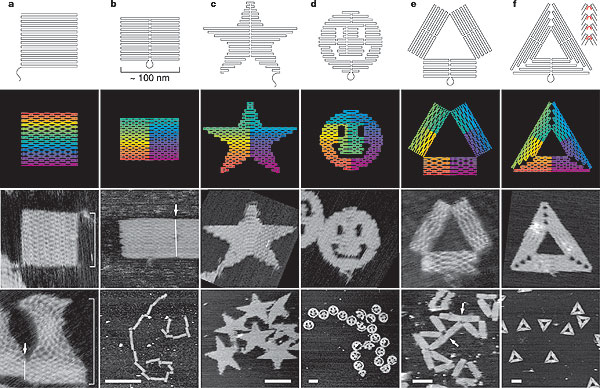
CAD Programmed DNA
Almost seven years after the original technique of DNA origami was developed by Paul Rothemund at the California Institute of Technology, Dr. Ido Bachelet and his team evolved the concept of DNA origami into a radical new drug delivery system. In Dr. Bachelet’s recent publication ‘Designing a bio-responsive robot from DNA origami‘ his team was able to take the genome of a virus as the primary building block of his structure and create a cage like scaffolding that has the capability to house life promoting drugs such as antibiotics and chemotherapy medicines.
However, these nanorobots not only have the ability to house powerful medicines; they can also deliver the drugs to the precise location that requires healing.
The current version of these nanorobots are free floating robots that float through the bloodstream by the billions and remain neutral until they encounter a location that requires assistance. The nanorobots know that they have reached the proper location by molecular cues that are programmed into them to move from their closed neutral state to its open state (See image 2 below). These molecular cues act as the key to activate the neutralized nanorobot into combat ready mode, and tell it to treat the infection site, delivering the drugs directly to the cancerous spot or site of infection.
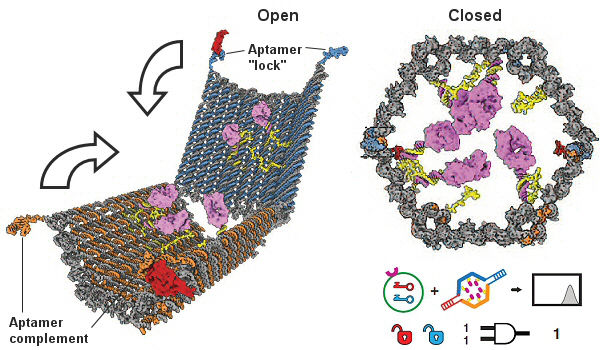
Nano
Currently, one of the primary problem with chemotherapy is that the drugs being injected into the patient are not only killing the rogue cancerous cells but healthy cells as well. By taking a sample of the cancerous cells, or by knowing the specific molecular markers of the rogue cells, scientists are able to program the nanorobots to only attack the enemy cells with a specific payload.
The idea is that the nanorobots don’t excrete the drug or release it. Instead, they make the drug accessible or inaccessible by turning it on and off. Because the drug is linked to the robot, one could think of it as a sword and the wielder. As the nanobot prepares to attack the cell that it was programmed to destroy, it enables its sword (the drug), that attacks the cell and then sheaths the drug again, leaving all of the healthy cells around the infection site unaffected by the potent chemotherapy drugs. Once could also think of this technology as predator dronedrone that have the ability to hone in and wipe out any enemy insurgents while leaving the healthy citizen population unaffected by the combat.
I’m sure some of you are asking ‘what happens when these nanorobots have achieved their objective? I don’t want millions maybe even billions of loaded nanorobots with powerful chemo drugs floating in my body.’ The nanorobots have a half-life of an hour or two, but scientist can modify them to live up to 3 days before they start the disintegration process, which is via enzymes. These enzymes slowly start to form segregates about a half-micron in size (size of bacteria).  As they slowly dismantle the nanobot, the payload is gradually released into the body at non-lethal doses until the enzymes have completed their task of disassembling, leaving the body free of the cancer and of any nanorobots.
FUTURE IMPLICATIONS
The current model of nanobots are extremely efficient in disengaging certain types of cells or delivering payloads to specific sites in the body. However, for diseases such as Alzheimer’s disease or Parkinson’s disease, where the body suffers a death on the molecular level, these nanobots are non-effective. In the future, it is possible that we will see an all-in-one nanorobot package. These nanobots would not only have the ability to destroy cells but promote the rejuvenation of cells without increasing likelihood of tumors or cancers as well.
Another additional future functionality that we will see in coming nanorobot versions is the ability to direct or steer nano particles to the precise location that requires treatment. Technically, this would be creating a new surgeon; the Nanorobot Surgeon. These doctors would have the ability to cut, stitch, and sample cells without ever having to perform what we consider modern day surgery. Dr. Bachelet and his team have already connected these nanorobots to an Xbox controller, acting as the conductor to a symphony of nanorobots working in unison to eradicate cancerous cells. These systems of controlling these nanorobots will grow in complexity and sophistication, completely changing the coming face of healthcare around the world.

Tuesday, August 6, 2013

The Psychology of Failed Predictions

Psychology plays a role in every decision that we make, to choosing a mate and starting a family, to the advertisements that persuade us in purchasing the latest electronics. But, what role does psychology play when it comes to our ability to predict world events or the latest emerging technologies? Is it possible that we are limited to certain psychological barriers that hinder our ability to reasonably survey and forecast future events? In a new study by Machine Intelligence Research Institute (MIRI) describes ‘How We’re Predicting AI – or Failing To’ by Stuart Armstrong and Kaj Sotala. It shows that there is substantial evidence for suspicion when it comes to our ability to predict future events. According to the data in the study, it is possible that forecasters could struggle with subconscious psychological predispositions that hinder their ability generate successful forecast. This study was not limited to expert forecast, but also included the forecast of non-experts, and cites data that shows there is an indistinguishable difference between the predictions of expert and non-expert forecasters.

Figure 1: “Median estimate for human-level AI, graphed against date of prediction” (1).

One of the most common mistake that expert and non-expert forecasters make is the so-called Maes-Garreau Law formulated by Kevin Kelly that states, forecasters will predict that a certain event with happen within their life time. “In this case, the rise of AI that will save them from their own deaths, akin to a Rapture of the Nerds” (1), a second mistake that forecasters make is that ‘event X is within 20 years’.
Figure 2: “Difference between the predicted time to AI and the predictor’s life expectancy, graphed against the predictor’s age” (1).

In order to compile and execute more accurate forecast and predictions, it is important that we understand our psychological procedures that could obstruct our vision of the future. By doing so, it could allow us to peer into the future with unbiased eyes, and a fresh perspective of what is logically possible according to our data, and not blindly project our ego onto our scenarios and forecast.

SOURCE: (1) HTTP://INTELLIGENCE.ORG/FILES/PREDICTINGAI.PDF

Sunday, June 23, 2013

End of Moore's Law

-->
According to Moores Law the number of transistors on a integrated circuit doubles approximately every two years (18 months). Gordron E. Moore described his law in this 1965 paper ‘Cramming more components onto integrated circuits’ in the Electronics Magazine. Because of this exponential growth over the last 48 years, this doubling has lead to 24 doublings of the orginal number of transitors that could be placed on a circuit board. Moore’s law is starting to buckle, because transistors based on semiconductors can only get so small.
"At the rate the current technology is progressing, in 10 or 20 years, they won't be able to get any smaller," said physicist Yoke Khin Yap of Michigan Technological University. Not only is the current technology starting to reach the mature phase of its growth (top of the S curve), but semiconductors also have another disadvantage: they waste an exorbitant amount of energy in the form of heat.
Over the last few decades scientist have experimented with different materials and molecule designs to continue Moore’s Law of exponential growth. However, these scientists have continued to experiment with semiconductor similar silicon. Dr. Yap wanted to try something novel, something that might open the floodgates for a new age of electronics.
"The idea was to make a transistor using a nanoscale insulator with nanoscale metals on top," he said. "In principle, you could get a piece of plastic and spread a handful of metal powders on top to make the devices, if you do it right. But we were trying to create it in nanoscale, so we chose a nanoscale insulator, boron nitride nanotubes, or BNNTs for the substrate."
Yap’s research team had figured out how to make a “virtual carpet” of BNNTS, which happen to be insulators (that are highly resistant to electrical charge). By using a laser, the team placed quantum dots (QDs) of gold as small as three nanometers across on top of the BNNTs, forming QB-BNNTs. 
When Yaps and Oak Ridge National Laboratory (ORNL) an organization that Yap’s team collaborated with fired electrons through both ends of the QB-BNNTs at room temperature. The electrons jumped with precision from gold dot to gold dot. By a phenomenon known as quantum tunneling.
"Imagine that the nanotubes are a river, with an electrode on each bank. Now imagine some very tiny stepping stones across the river," said Yap. "The electrons hopped between the gold stepping stones. The stones are so small, you can only get one electron on the stone at a time. Every electron is passing the same way, so the device is always stable."
Yap’s team had made a transistor without using a semiconductor. When sufficient voltage was applied, it switched to a conducting state, and when the voltage was low or turned off, it reverted to its natural state as an insulator. During this process there was no leakage. Meaning, no electrons from the gold dots escaped into the insulating BNNTs, allowing the tunneling channel to remain at a cool temperature, while silicon is subject to leakage, that waste energy and generates a lot of excess heat.
The method that separates Yap’s success to others who have tried to exploit quantum tunneling is that Yaps gold-and-nanotube device is its submicroscopic size: One micron long and about 20 nanometers wide.  “The gold islands have to be on the order of nanometers across to control the electrons at room temperature," Jaszczak said. "If they are too big, too many electrons can flow." In this case, smaller is truly better: "Working with nanotubes and quantum dots gets you to the scale you want for electronic devices."
"Theoretically, these tunneling channels can be miniaturized into virtually zero dimension when the distance between electrodes is reduced to a small fraction of a micron," said Yap.

FUTURE IMPLICATIONS
With Moore’s Law is coming to an end in the next 10 to 20 years, a new technology must raise to take its place to continue the technological development that has been seen in the last 50 years. In the future, we are going to see more scientists using quantum phenomena to over come the traditional physical barriers that are starting to loom and threaten technological development.  Yap’s method could continue Moore’s law along with creating more power efficient devices that could go days without being charged.